You don’t have a lead problem. You have a reply problem.
Every new sales manager asks for the same thing in the first month: more leads.
Check something else first.
Researchers once sent a sales enquiry to 2,241 companies, through each company’s own website, and timed the replies. Nearly one in four never answered.
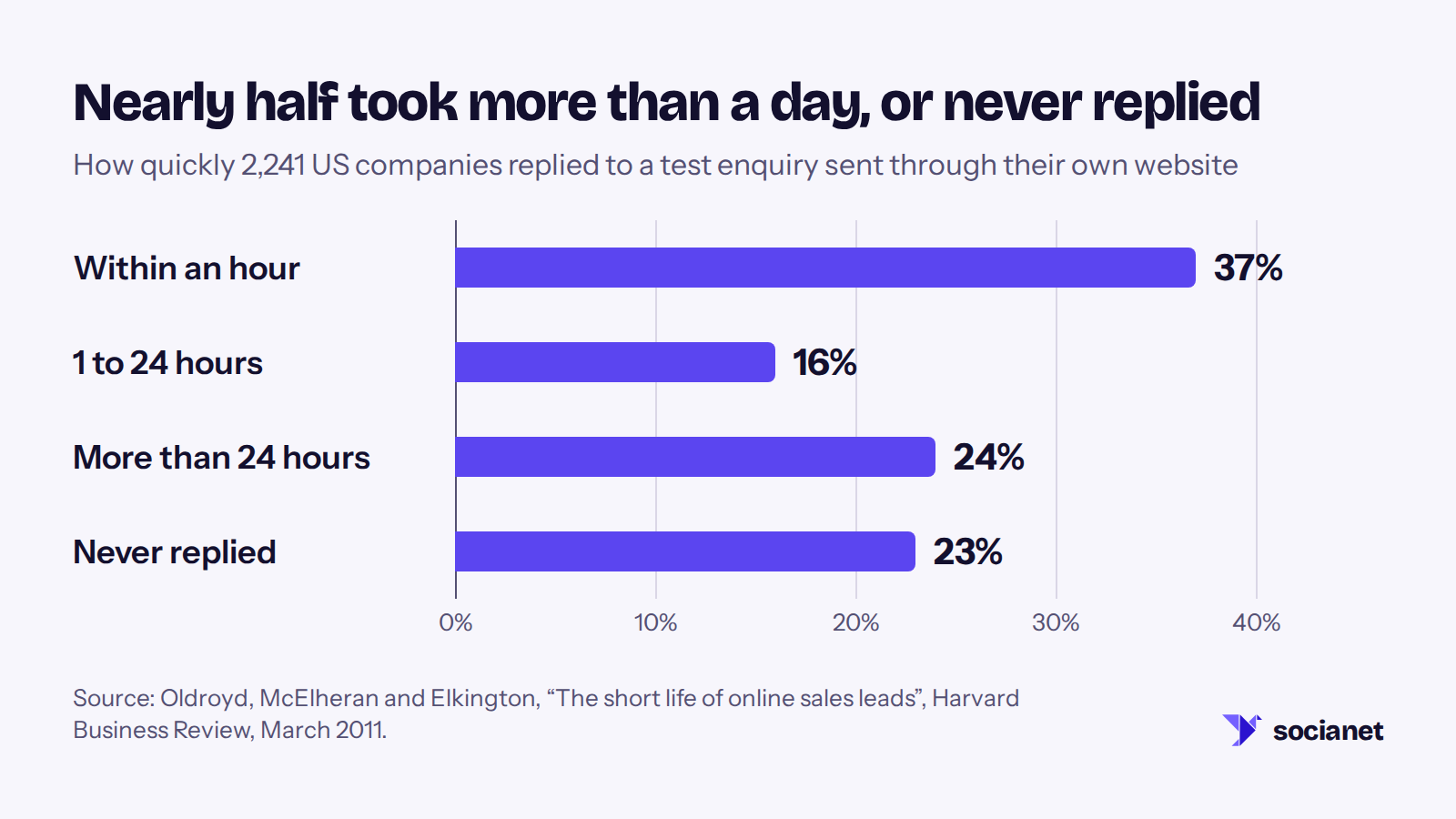
37% replied within an hour. 16% took between one and 24 hours. 24% took longer than a day. 23% never replied at all. Among the companies that did reply within 30 days, the average wait was 42 hours. The study, by James Oldroyd, Kristina McElheran and David Elkington, ran in Harvard Business Review in March 2011.
Every one of those companies had a form on its website asking for enquiries. Then the enquiry sat there.
So before you ask for more leads, find out what happens to the ones you already get. One number tells you: how long a new enquiry waits before a person on your team replies.
Why the wait matters
The same article looked at 1.25 million sales leads received by 42 companies. Firms that tried to make contact within an hour were nearly seven times as likely to have a real conversation with a decision-maker as firms that tried even an hour later.
A second study, presented in 2007, looked at phone calls to web leads: more than 15,000 leads at six companies. It reported that the odds of reaching a lead were 100 times lower when the first call came after 30 minutes instead of five.
What the research does not say
I sell a CRM, so I have every reason to oversell these numbers. Here is what they do not show.
- Neither study measured closed sales. They measured whether you got a real conversation.
- Both are American, both are about web forms followed up by phone or email, and the newer one is 15 years old.
- I have not found a published study of reply times on WhatsApp, which is where a great deal of selling now happens.
- The line you will see everywhere, that 78% of customers buy from the first company to respond, I could not trace to any study at all.
So the direction is solid: the sooner a person replies, the more conversations you get. The exact number of minutes is not proven.
How to get your own number this week
It takes an afternoon and a spreadsheet.
- Define it. Response time is the gap between the lead’s first message and the first reply from a person. Automatic replies do not count.
- Take a sample. Your last 50 leads, or everything from the last 30 days.
- Record two timestamps for each lead. The first message in and the first human reply out, plus the channel and the rep.
- Use the median, not the average. One lead answered after four days will distort an average.
- Split working hours from out of hours. They are different problems.
What good looks like
These are working targets I suggest for a team of 3 to 50 people. No study sets them. Change them once you have your own numbers.
| Situation | A reply from a person |
|---|---|
| WhatsApp or web form, in working hours | Within 5 minutes |
| Email enquiry, in working hours | Within 30 minutes |
| Missed call | A message within 1 minute, a call back within 15 |
| Any channel, out of hours | In the first 30 minutes of the next working day |
In every case, an automatic acknowledgement goes out within seconds.
Fix this before you ask for more leads
It is the cheapest win a new manager can get. You do not need more leads, more people or a new script. You need the enquiries you already have to be answered sooner, and the team can see the number move within a fortnight.
It also tells the team something about you early on: you measure things they control.
If your number is good, you have earned the right to ask for more leads. If it is not, you have just found your first month’s work.
See where your leads slip
If you want to see where leads slip in your own process, the 2-minute Leak Score quiz gives you a score and the first thing to fix.
